
94% of European businesses expect growth in 2027. But new research reveals a striking difference between the companies most confident about their future and those still finding their footing. And it has less to do with AI than you might think.
European businesses are optimistic about the year ahead. According to SuperOffice's European Growth & Technology Outlook 2027, 94% of surveyed companies expect growth over the next 12 months. Almost half (46%) are strongly optimistic, while another 49% are cautiously optimistic.
But that optimism isn't evenly distributed. Companies with connected business systems and AI that's already delivering measurable results are significantly more confident about growth than those still working with fragmented systems.
In fact, 77% of companies with fully integrated systems and advanced AI capabilities are strongly optimistic about growth, compared with just 26% of companies with fragmented systems and less mature AI adoption. That's nearly three times the level of growth confidence.
So, what are these companies doing differently, and what can other European B2B businesses learn from them?
We surveyed 371 business decision-makers across Norway, Sweden, Denmark, Germany and the Netherlands to find out.
Meet the 27%: Europe's Connected Growth Leaders
Our research identified two distinct groups of companies based on how well their systems are connected and how effectively they're using AI.
The first group, which we call Connected Growth Leaders, represents 27% of the businesses surveyed. These companies have fully integrated their core business systems, allowing customer information to flow between tools and teams. They're also using AI in ways that already deliver measurable business results.
The second group, Fragmented Companies, represents 39% of the sample. Their systems are only partially integrated or not integrated at all, and their AI adoption is still largely in the experimentation or evaluation stage.
The differences between these groups go well beyond technology. Connected Growth Leaders report substantially higher confidence in their growth prospects, GDPR compliance and ability to oversee AI usage.
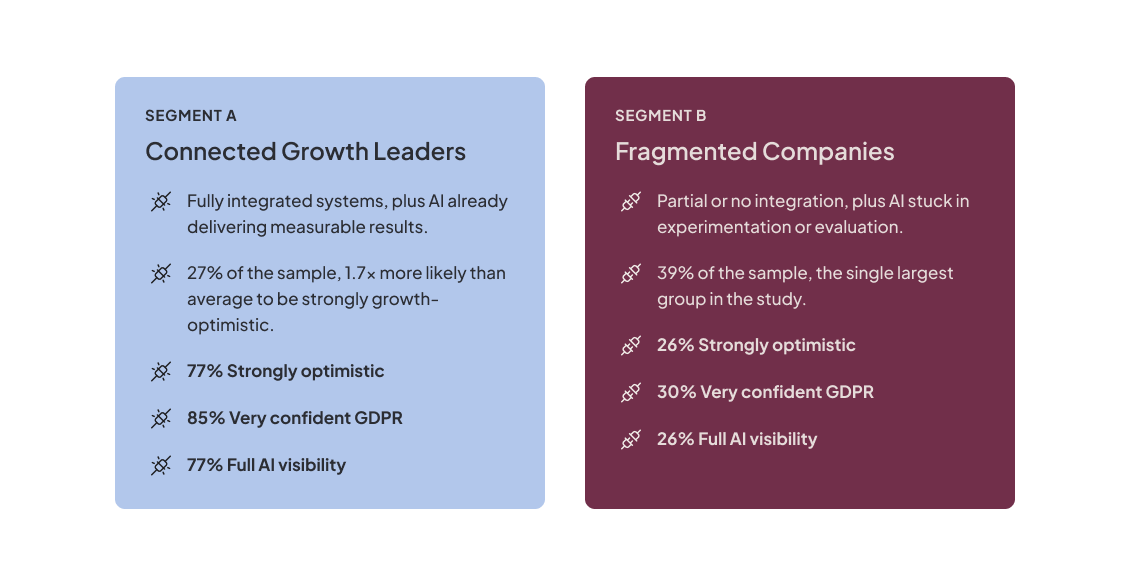
Connected Growth Leaders (27% of respondents) report significantly higher growth confidence, GDPR confidence and AI visibility than Fragmented Companies (39% of respondents). Source: SuperOffice, European Growth & Technology Outlook 2027.
Connected Growth Leaders are nearly three times as likely to be strongly optimistic about growth. They're also substantially more confident in their ability to manage customer data and oversee AI usage.
These are self-reported measures of confidence and visibility, rather than verified business performance. However, the consistency of the differences suggests that businesses with more connected systems and mature AI capabilities also feel better equipped to manage growth, compliance and technological change.
And when we look more closely at the findings, system integration appears to play a particularly important role.
Why system integration matters more than AI alone
AI has become a major part of almost every conversation about business growth. Yet our research suggests that investing in AI without first connecting your business systems may limit the value you get from it.
Among fully integrated companies that haven't reached advanced AI adoption, 47% are strongly optimistic about growth. Among companies with fragmented systems but advanced AI capabilities, that figure is just 40%.
In other words, companies with connected systems and relatively basic AI capabilities report greater growth confidence than companies using advanced AI on top of fragmented systems.
That doesn't mean AI isn't valuable. When businesses combine connected systems with AI that's already delivering measurable results, growth confidence rises to 77%. The findings reinforce why quality data is the backbone of any AI strategy, particularly when AI is expected to support real business decisions.
Consider a sales team using AI to prepare for customer meetings. If the AI tool can only access information from one system, it might miss important context from previous conversations, service requests or ongoing opportunities. But when customer data is connected, the same tool can work with a much fuller picture, helping salespeople prepare relevant follow-ups, identify opportunities and spend less time searching for information.
The technology hasn't necessarily changed. What has changed is the quality and completeness of the information available to it.
As Camilla Heidenreich Bommen, Chief Commercial Officer at SuperOffice, puts it:
"AI built on top of fragmented data just moves the mess faster."
European businesses are already prioritising integration
Companies appear to recognise this challenge themselves. When asked which technology investment they would prioritise over the next 12 months, system integration came out on top.
- 38% prioritise better integration between existing business systems.
- 28% prioritise adopting or expanding AI tools.
- 20% prioritise investing in a new CRM or data platform.
Rather than immediately adding more tools, many European businesses are looking for ways to make their existing technology work better together.
Our research found that 52% of companies use two or three separate systems to manage customer data, while another 28% use four to six. When those systems don't communicate properly, teams can end up working with different versions of the same customer relationship.
This is particularly noticeable when CRM and ERP systems aren't connected, leaving sales and finance teams working from different information.
Sales might have one view of a customer, marketing another and customer service a third. Connecting those systems helps create a more consistent picture, making it easier for teams to collaborate, understand customer needs and make informed decisions. A connected CRM platform can help bring that information together, giving teams a more complete view of their customers.
What connected customer data means for sales, marketing and service
System integration can sound like an IT project, but its impact is felt by the people working with customers every day.
For sales teams, connected customer data means having a clearer picture of the pipeline, previous conversations and upcoming opportunities. Marketing teams can better understand how customers engage across different touchpoints, while service teams gain access to relevant purchase histories, previous requests and customer commitments.
The value isn't simply having more data. It's having the right information available when someone needs it.
This also helps explain where European businesses are already seeing results from AI. Among respondents who could identify meaningful AI benefits, the three most frequently selected areas were:
- 18%: Faster or better personalised customer communication.
- 16%: Automation of repetitive sales or administrative tasks.
- 13%: Automated document creation, including proposals and contracts.
These are practical improvements to everyday work, and all three benefit from accurate customer information. Some are already possible with the AI capabilities available in SuperOffice CRM, from preparing for meetings to helping teams respond to customers more efficiently.
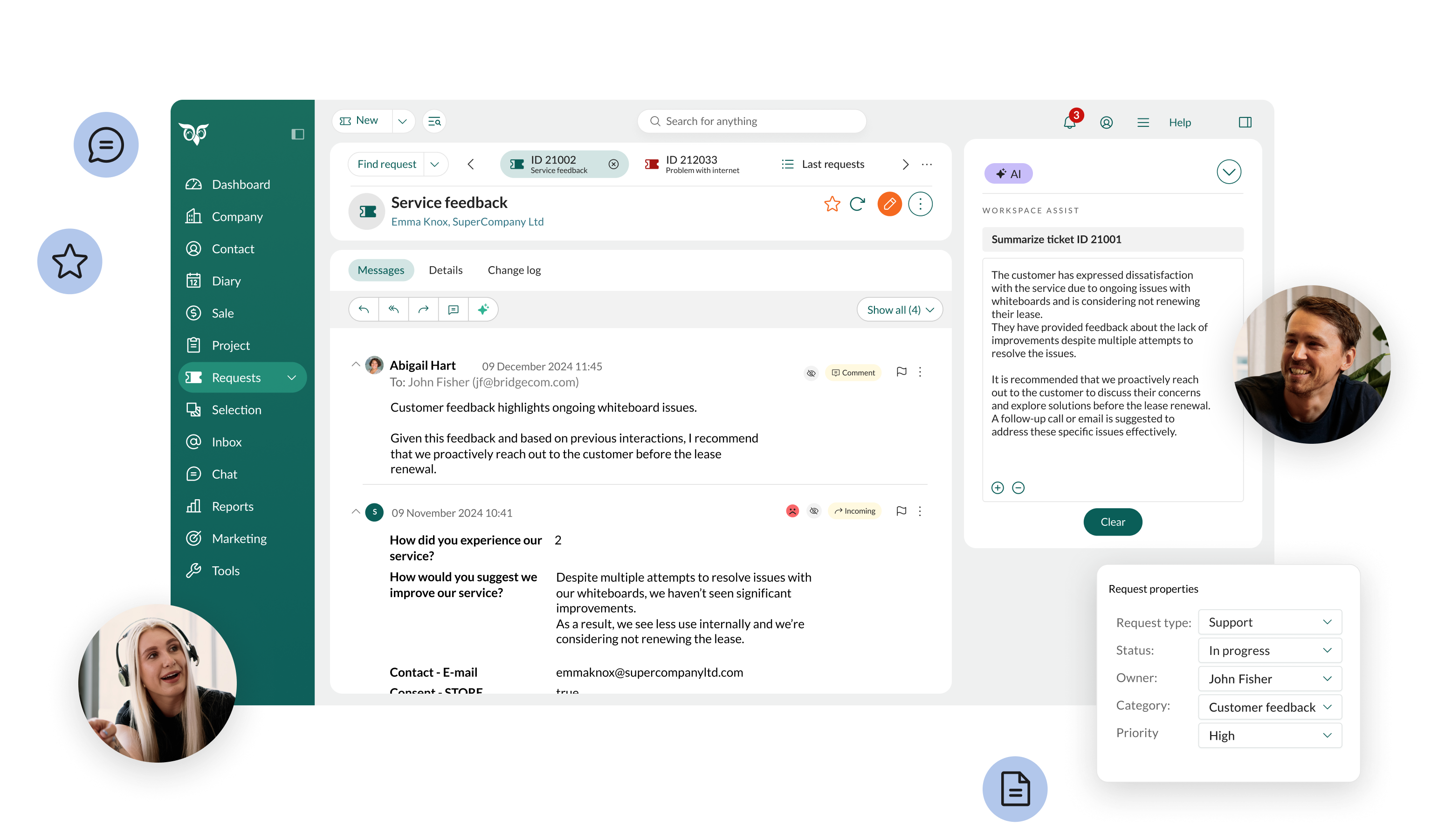
An AI tool can help draft a follow-up email, but to make that email genuinely relevant, it needs to understand the customer relationship. It can help create a proposal, but the result will be more useful if it has access to the correct deal details, requirements and previous discussions.
This is where connected customer data and AI can work particularly well together. One provides the context, while the other helps teams put it to use.
Growth confidence isn't the only difference
The advantages associated with connected systems extend beyond growth expectations. Our research also found substantial differences in how confident businesses feel about data protection and AI governance.
Among Connected Growth Leaders, 85% report being very confident in their GDPR compliance, compared with just 30% of Fragmented Companies. The difference is similarly striking when it comes to AI oversight: 77% of Connected Growth Leaders report full visibility into how AI is being used within their organisations, compared with 26% of Fragmented Companies.
These differences matter because businesses are increasingly relying on AI tools that interact with company information, customer data and internal processes. Knowing that an AI policy exists is one thing. Knowing whether it's being followed is another.
Across the entire survey, 88% of companies say they have a clear AI usage policy, but only 43% report full visibility to monitor and enforce it. This points to a considerable difference between the policies businesses have introduced and their ability to oversee how AI is actually used.
The relationship with growth confidence is also notable. Among companies with full AI policy visibility, 63% are strongly optimistic about growth. Among those without it, only 32% say the same.
While these findings don't establish that stronger AI oversight directly causes greater growth confidence, they reveal a consistent relationship between visibility, control and optimism. For businesses planning to expand their use of AI in 2027, that relationship is worth paying attention to.
Three priorities for B2B growth in 2027
The findings suggest that European businesses don't necessarily need more technology to improve their readiness for growth. In many cases, the opportunity lies in making better use of the systems, information and relationships they already have.
Based on the research, three priorities stand out.
1. Connect your business systems before scaling AI
Before investing in another AI tool, take a closer look at how information moves through your business. Can sales, marketing and service access the customer information they need? Are your systems sharing data automatically, or are employees still copying information between tools?
Connecting existing systems can create a more reliable foundation for future technology investments. That doesn't necessarily mean replacing everything you already use. It means making sure the tools you depend on can work together and provide consistent information across teams.
2. Make AI oversight part of everyday work
Having an AI policy is a good starting point, but a policy alone doesn't tell you how employees are actually using AI.
As AI becomes more embedded in daily workflows, businesses need a clearer understanding of which tools are being used, what information they can access and whether internal guidelines are being followed.
This isn't just a question for IT or compliance teams. It's increasingly relevant to anyone responsible for customer relationships, business operations or growth.
3. Get more value from the customers and tools you already have
One of the more interesting differences between Connected Growth Leaders and Fragmented Companies is how they approach growth.
Among Connected Growth Leaders, improving sales and commercial productivity is the top growth priority at 28%, slightly ahead of acquiring new customers at 27%. Fragmented Companies take a different approach. New customer acquisition leads at 27%, while productivity ranks third at 18%.
Both groups want to grow, but Connected Growth Leaders place slightly more emphasis on improving how their existing teams work.
For businesses planning their 2027 strategy, that's an important consideration. Growth isn't only about bringing in more customers. It's also about making better use of existing relationships, helping employees work more effectively and removing unnecessary friction from everyday processes. With a clearer view of customer needs and buying signals, teams can also identify more relevant opportunities for upselling and cross-selling.
What does this mean for European B2B growth in 2027?
The outlook for European business growth is overwhelmingly positive, but optimism alone doesn't tell the whole story.
Our research shows that companies with connected systems and mature AI capabilities are substantially more confident about their growth prospects than those still working with fragmented information. The same companies also report greater confidence in their GDPR compliance and stronger visibility into how AI is being used.
These findings don't mean every business needs to reach the same level of technological maturity overnight. They do, however, suggest that the foundations businesses build today could make a meaningful difference to how confidently they approach the future.
For sales, marketing and service teams, the starting point is often practical: better access to customer information, fewer disconnected processes and technology that helps people do their jobs.
When systems work together, people can spend less time searching for answers and more time building relationships. And that's a good foundation for growth.
Discover what European businesses are planning for 2027
The findings in this article are just part of the picture. Explore the full European Growth & Technology Outlook 2027 report for more insights into growth confidence, AI adoption, connected systems and the priorities shaping European businesses.
Research methodology: SuperOffice commissioned the study in partnership with research agency Datalily, using the Centiment survey panel. The research included 371 decision-makers and strong influencers responsible for CRM, customer data or AI technology decisions at companies with 30–300 employees in Norway, Sweden, Denmark, Germany and the Netherlands. Respondents represented B2B and mixed B2B/B2C businesses. The findings reflect survey responses and reported expectations, rather than independently verified growth outcomes.


