
The difference in short
Salesforce is the world's largest CRM, built for large enterprises with dedicated admin teams and high IT budgets. SuperOffice is purpose-built for European B2B companies that want a CRM platform their teams will actually use, with EU data hosting by default, local-language support, and fast setup that doesn't need a consultant. On G2, both platforms carry the same 4.4/5 overall rating, but SuperOffice pulls ahead on ease of use, setup speed, and support quality, while Salesforce pulls ahead on feature depth and meeting complex requirements. If your team is under 500 people and based in Europe, that trade-off is worth understanding before you shortlist either one.
Comparing SuperOffice CRM and Salesforce for your business?
Both are established CRM platforms. Both promise pipeline visibility, sales automation, and better customer relationships. But beneath those shared goals, they are built for very different types of organisations.
Salesforce is the global market leader, serving over 150,000 customers worldwide, including 83% of the Fortune 500. It is an enterprise-grade platform built for scale, deep customisation, and a large internal IT team to manage it.
SuperOffice has been building CRM for European B2B companies for over 30 years. It is designed to be used, not just implemented. One integrated platform for sales, marketing, and service, with EU data hosting, local support, and a setup that gets teams live in days, not months.
In this article, we compare SuperOffice CRM vs Salesforce on the things that matter to growing European businesses: usability, pricing, GDPR compliance, implementation, and support.
Why compare SuperOffice and Salesforce?
Both CRMs manage contacts, track sales pipelines, and connect customer data across teams. For European B2B companies, they appear on the same shortlists.
But the gap in fit is significant.
Salesforce was built for large enterprises and has grown into a vast platform of modular products, add-ons, and partner ecosystems. For the right organisation, it is extremely powerful. For a mid-sized European sales team, it can be expensive to configure, slow to adopt, and complex to maintain.
SuperOffice was built for European B2B teams from the start, with an emphasis on usability, local compliance, and the practical reality of running sales, marketing, and service from one system. It is not trying to serve everyone. It is trying to serve European SMBs and growing mid-market companies exceptionally well.
That difference matters more than it might seem at the shortlist stage. If you're weighing up how different CRM models fit different team structures, our guide to types of CRM is a useful starting point.
SuperOffice CRM vs Salesforce: head-to-head comparison
See how SuperOffice and Salesforce compare on the features that matter most to European B2B teams.
| Feature | SuperOffice CRM | Salesforce |
| Origin | Norway European-built, GDPR-first by design | USA – global platform, EU data options on higher tiers |
| Focus | Full B2B CRM for sales, marketing, and service | Broad enterprise platform across CRM, ERP, analytics, and AI |
| Easy to use | Fast Track templates for guided setup; user-friendly interface | Powerful but complex; steep learning curve; typically requires training and admin support |
| Ease of use (G2 score) | 8.7/10 | 8.2/10 |
| Ease of setup (G2 score) | 8.1/10 | 7.8//10 |
| Quality of support (G2 score) | 8.8/10 | 8.1/10 |
| Overall CRM feature depth (G2 category score) | 7.2/10 | 8.2/10 |
| Sales tools | Guided pipelines, sales automation, forecasting, AI-assisted follow-up | Deep sales tooling across pipeline, forecasting, and AI – but many features require higher-tier licences |
| Marketing | Built-in email marketing, automation, and web forms across all plans | Marketing Cloud is a separate, enterprise-grade product with its own licence and cost |
| Customer service | Shared inbox, case management, and service requests built in | Service Cloud is a separate module with separate pricing |
| Customisation | High flexibility without developers; configurable to your process out of the box | Extremely customizable, but often requires Salesforce-certified developers or implementation partners |
| Mobile app | Full-featured mobile CRM included | Mobile CRM app available; feature parity varies by plan |
| AI and automation | AI and CRM built into all plans | Einstein AI available across platform; most advanced features require higher tiers |
| Integrations | SuperOffice AppStore ecosystem, ERP and CRM, Outlook, Microsoft 365, Gmail, Power BI, and European-specific integrations | AppExchange ecosystem with 5,000+ apps; strongest with US-market tools |
| GDPR compliance | GDPR compliance built by design; EU hosting included; ISO-certified infrastructure; consent management built in | GDPR compliant; EU data residency available on higher-tier plans; requires configuration |
| Data hosting | European servers, included on all plans, no additional configuration needed | US by default; EU region available on Enterprise and above |
| Deployment | Cloud or on-premise | Cloud only |
| Implementation | Days to weeks with Fast Track templates; no external partner required | Typically 3–12 months; most implementations require a certified Salesforce partner |
| Support | Local-language support and in-region teams across Europe | Global support model; local-language support varies by region and plan |
| Pricing | One price, the full suite. Pay more only as you grow | Complex tiered pricing; many features locked behind higher plans; add-on costs accumulate quickly |
G2 scores sourced from G2's SuperOffice CRM vs Agentforce Sales (formerly Salesforce Sales Cloud) comparison page, July 2026.
Which CRM is right for your sales team?
Choose SuperOffice CRM if you want:
1. A CRM your team will want to use
The most expensive CRM is the one your team avoids. This Is also why understanding why sales people need CRM in the first place matters more than any feature list.
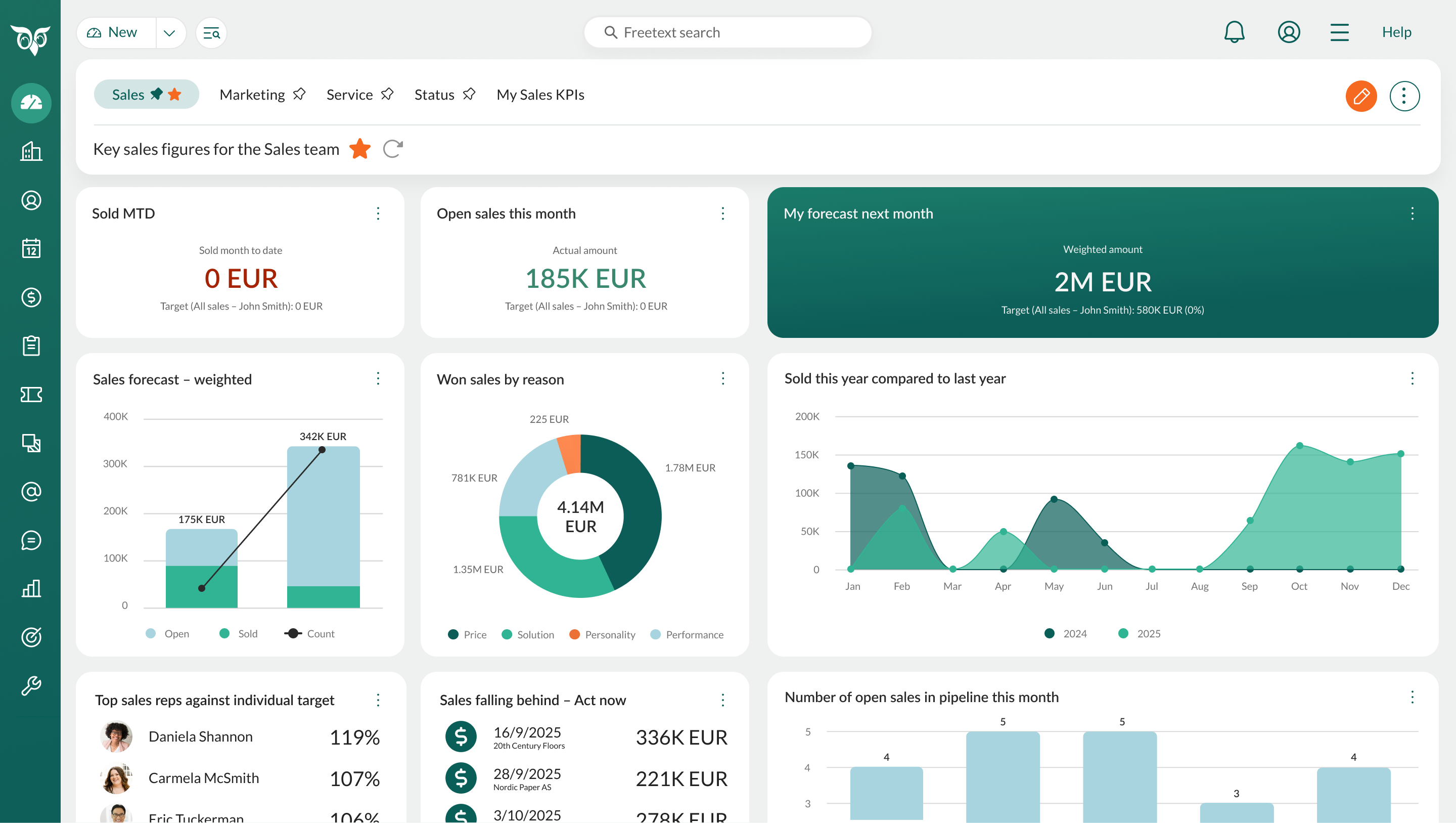
SuperOffice is designed around the people doing the work: sales reps, service teams, and marketing managers who need a tool that fits their day, not one that adds to it. From marketing automation and email outreach to sales follow-up and customer service, everything runs in one seamless customer experience.
Adoption is where most CRM investments succeed or fail. On G2, SuperOffice scores 8.7/10 on ease of use against Salesforce's 8.2/10, and 8.1/10 on ease of setup against Salesforce's 7.8/10. SuperOffice is built to win that adoption battle.
2. EU data hosting and GDPR compliance without the configuration overhead
For European businesses, data sovereignty is not a nice-to-have. It is a legal requirement and, increasingly, a commercial one too.
SuperOffice hosts all customer data on European servers, included as standard, across all plans, with no additional configuration required. It is GDPR-first by design, with consent management, ISO-certified infrastructure, and transparent data processing built into the platform.
You do not need to check whether your data is in Europe. It already is.
3. One integrated platform, not a collection of modules
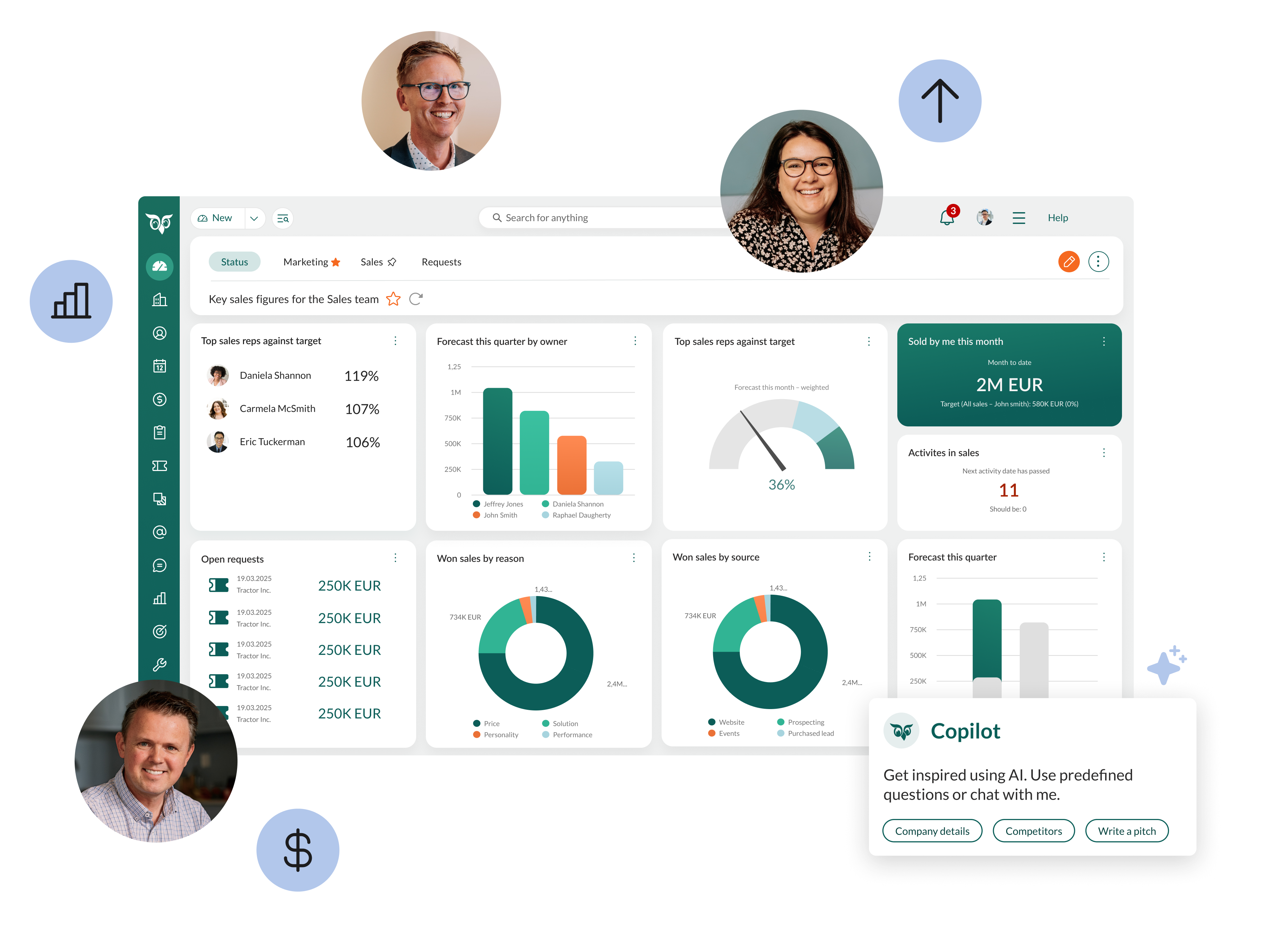
SuperOffice gives your sales, marketing, and service teams a single shared view of every customer relationship. No separate hubs, no additional licences to unlock features you expected to be included. This is also central to the cost of manual work story: every disconnected tool is another place work has to be re-entered by hand.
When a service team closes a case, the sales team sees it. When marketing sends a campaign, the sales team knows who opened it. Everyone works from the same data, at the same time, in the same system.
That alignment is what turns a CRM into a growth tool.
4. Local support and a partner who knows your market
SuperOffice has been building CRM for European businesses since 1990. That means local offices, local-language support, and a deep understanding of how B2B sales works across the Nordics, DACH, Benelux, and the UK.
On G2, SuperOffice scores 8.8/10 on quality of support against Salesforce's 8.1/10. When something goes wrong, or when you need help getting more out of your system, you are not waiting for a global support queue. You are talking to someone who knows your market.
Choose Salesforce if you want:
1. Enterprise-scale customisation and a vast partner ecosystem
If your organisation has a large internal IT team, a Salesforce-certified admin, and complex requirements across multiple business units, Salesforce's depth is genuinely unmatched. On G2, Salesforce scores 8.8/10 on "meets requirements" against SuperOffice's 8.3/10, and leads on overall CRM feature depth (8.2/10 vs 7.2/10).
The AppExchange marketplace, deep API access, and the breadth of the platform make Salesforce the right choice for organisations that need a CRM to bend entirely to their existing processes, and have the resources to make that happen.
2. Advanced AI and analytics at enterprise scale
Salesforce's Einstein AI platform, combined with Data Cloud and Analytics, offers some of the most sophisticated data tooling available in any CRM.
For large sales organisations running complex, data-heavy operations, this is a genuine differentiator, provided you are on the plans that include it and have the team to configure and maintain it.
3. A platform that connects to your wider Salesforce investment
If your organisation already uses Salesforce for other functions – marketing, service, commerce, or ERP – there is a logical case for consolidating onto one platform.
The integration benefits are real, as is the lock-in. If you are already embedded in the Salesforce ecosystem, switching costs are significant.
Which CRM meets your business needs?
Use this table to match your priorities to the right platform.
| Business need | SuperOffice CRM | Salesforce |
| EU data hosting included as standard | Yes – all plans, no configuration needed | EU region on Enterprise plans only; requires setup |
| GDPR compliance built in | Yes – consent management, ISO-certified | GDPR compliant; tools vary by plan and configuration |
| Fast implementation wothout a partner | Yes – days to weeks with Fast Track | Typically months; most teams use a certified partner |
| All-in-one sales, marketing and service | Yes – one platform, no add-on hubs | Separate products (Sales Cloud, Marketing Cloud, Service Cloud) |
| Highest-rated ease of use and setup | Yes – 8.7/10 ease of use, 8.1/10 ease of setup on G2 | 8.2/10 ease of use, 7.8/10 ease of setup on G2 |
| Transparent, modular pricing | Yes – pay for what you use | Complex tier structure; many features require upgrades |
| Local-language support across Europe | Yes – in-region teams | Available in some markets; varies by plan |
| Deep enterprise customisation and feature range | Strong for SMB and mid-market | Industry-leading; best for large enterprises with IT teams |
| Advanced AI and analytics at scale | AI across all plans; strong for SMB needs | Einstein AI and Data Cloud; most powerful at Enterprise tier |
| Large third-pary app ecosystem | Strong European integrations; ERP-connected | AppExchange with 5,000+ apps; strongest for US-market tools |
If your organisation is a large enterprise with a dedicated Salesforce team and a strong existing investment in the platform, Salesforce is likely the right answer.
But if you are a European B2B company – growing, pragmatic, and looking for a CRM your team will find easy to use – SuperOffice is built for exactly that. For a broader look at fit beyond just SuperOffice and Salesforce, see our guide to best CRM for European businesses and our roundup of the best sales CRM options for 2026.
Why trust SuperOffice on this comparison?
SuperOffice has been building CRM software for European B2B businesses since 1990. That is over 30 years of working with sales teams, service managers, and commercial directors across the Nordics, DACH, Benelux, Switzerland, and the UK.
We are not a US platform with a European office. We are a European CRM company, founded in Oslo, with deep roots in the markets we serve. We understand what GDPR means in practice, how B2B sales works across different European markets, and what it takes to build a CRM that teams adopt rather than avoid. That focus shows up in the numbers: SuperOffice consistently outscores Salesforce on G2 for ease of use, ease of setup, and quality of support, even with a much smaller review base.
Our customers include thousands of growing SMBs and mid-market companies across Europe. When we describe the differences between platforms, we are drawing on three decades of real implementation experience.
Conclusion
Both SuperOffice and Salesforce are serious CRM platforms, and both carry the same 4.4/5 overall rating on G2. The choice between them is not really about who scores higher overall. It is about fit.
Salesforce wins on feature depth and meeting complex requirements. It's built for enterprises with the resources to configure, maintain, and scale a highly complex system. For large organisations with global operations and a dedicated Salesforce team, it is difficult to beat.
SuperOffice wins on ease of use, ease of setup, and quality of support. It's built for European B2B companies that want a CRM their teams will actually use, with EU data hosting as standard, local support, fast implementation, and one integrated platform that covers sales, marketing, and service without the hidden costs. If that sounds like your business, we are ready to show you what it looks like in practice.
See what SuperOffice can do for your team
Book a personalised demo and talk to one of our CRM experts. We will show you how SuperOffice can help your team work faster, sell smarter, and build stronger customer relationships.
Frequently asked questions
Yes,Salesforce is GDPR compliant. However, EU data residency is not included on all plans. By default, Salesforce stores data on US servers. EU data hosting is available on Enterprise and higher-tier plans, but requires configuration and, in some cases, additional cost. European businesses should confirm data residency and review the Data Processing Agreement before signing.
Yes. All SuperOffice customer data is hosted on European servers, included as standard across all plans, with no additional configuration or cost required. SuperOffice is GDPR-first by design, with built-in consent management, ISO-certified infrastructure, and transparent data processing. For European businesses handling personal data, this removes a significant compliance overhead.
The core difference is fit, not overall quality. Both platforms carry a 4.4/5 rating on G2. Salesforce is an enterprise-grade platform built for large organisations with dedicated admin and IT teams, significant implementation budgets, and complex customisation needs, and it scores higher on meeting complex requirements and feature depth. SuperOffice is purpose-built for European B2B companies that need a CRM their teams will adopt and use, and it scores higher on ease of use, ease of setup, and quality of support.
Not on entry-level list price. Salesforce's Starter Edition begins at $25/user/month, compared to SuperOffice's Starter plan at €45/user/month. The cost advantage for SuperOffice is in total cost of ownership: one plan covers sales, marketing, and service, with no separate Marketing Cloud or Service Cloud licence to add, and most teams implement without a certified partner. For Salesforce, matching that same scope typically means multiple product licences plus implementation cost. Compare total cost for your actual scope, not just the entry price.
SuperOffice implementations typically take days to a few weeks, using Fast Track templates designed for common B2B sales processes. Most teams do not need an external implementation partner. Salesforce implementations typically take three to twelve months, and the majority require a certified Salesforce partner. For European businesses under time pressure or without large IT teams, this difference is significant.
For most European SMBs, SuperOffice is the stronger fit. It offers EU data hosting by default, local-language support, fast implementation, and a single integrated platform for sales, marketing, and service, and it outscores Salesforce on G2 for ease of use, setup, and support. Salesforce is better suited to large enterprises with dedicated technical teams, existing Salesforce investments, and requirements complex enough to need its deeper feature set. A SuperOffice demo is a practical way to assess fit before committing.
Yes. SuperOffice supports data migration from Salesforce and most other major CRM platforms. The migration process typically involves exporting contacts, accounts, and activities from Salesforce in CSV format, cleaning the data, and importing into SuperOffice. SuperOffice's implementation team and local partners can support this process. Most teams find that active data from the past 12 to 18 months is sufficient to migrate, older records can be archived rather than transferred.
Related blogs:


