
TL;DR: 2026 was the year your company piloted AI. 2027 is the year you'll decide whether to operationalise it or abandon it. This article covers the real difference between having AI features and having an AI strategy; why data quality comes before capability, how to spot which AI investments actually work in your business, what your team needs to know about governance and trust, and how to choose a CRM built for European compliance. For sales leaders who need AI that amplifies their relationships, not replaces them.
2026 was the year of AI pilots. Your team tested it, maybe it saved time on a few tasks, maybe it hallucinated customer names, or maybe it just sat there, unused, because nobody was sure what it was really for.
By now, you've learned something: having AI and having a working AI strategy are not the same thing.
2027 is the year that gap closes (or expands). Companies that treat AI as a feature will abandon it, while those treating AI as a strategy – with clear intent, clean data, and the right governance – will operationalise it. The difference is not the AI itself, but the thought behind the use.
This article covers what that strategy looks like: how to move from experimentation to real ROI, why data quality is your competitive advantage, what governance and trust really mean in a European CRM, and how to tell the difference between AI that helps your sales team and AI that creates more work.
The Problem: Most European companies aren’t aware of what is happening with AI in their CRM, or in their business. Nearly half (48%) report only partial visibility into how their teams use AI with customer data. A quarter don't know where their customer data is hosted or which jurisdiction governs it. And 51% aren't confident they're fully GDPR-compliant. Meanwhile, the pressure to "do AI" keeps rising.
The Solution: A real AI strategy starts with three things: clean, owned data; clear governance and trust; and a vendor who understands European compliance from the ground up. It's an operating discipline, as opposed to another feature roll out.
The Proof: Companies with structured data and clear visibility into AI usage report 3–5x higher confidence in their AI outcomes (per SuperOffice’s own research). And 75% of manufacturing companies – a sector with strict compliance requirements – won't choose a CRM vendor unless their data stays in Europe.
From experimentation to operationalising AI
You've probably noticed the pattern by now.
2026: "Let's try this. See what works. Build pilots."
2027: "Which pilots actually moved the needle? Which ones wasted our time? And which failures taught us something worth knowing?"
The difference between a successful AI rollout and an abandoned one isn't the quality of the AI model. It's whether the company had a strategy before it deployed the technology.
What is an "AI strategy"?
Simply having access to agents or exchanging Copilot summaries doesn’t count as an AI strategy.
A good AI strategy is about:
- Clear intent: What is this AI supposed to do? Who benefits? How will we measure success?
- Clean data: Is the AI working with reliable customer records, or are we feeding it duplicates and outdated info?
- Visible governance: Can we see what is happening? Do we know where the data goes? Are we compliant?
- Realistic ROI: Did this save time or create rework? Is it worth the investment?
Companies that skip this – that just turn on features and hope – end up with a CRM that feels bloated and a team that doesn't trust it. When you get the strategy right, though, the synergy between CRM and AI starts to stimulate real growth.
Why data quality comes before AI capability
This is the point where most AI rollouts fail.
You already know the rule: garbage in, garbage out. But with AI in your CRM, the garbage moves faster and more confidently.
If your customer records are duplicated, outdated, or scattered across tools, AI doesn't fix but scales it. Your agents confidently suggest actions based on wrong data, Copilot drafts emails to the wrong contact, and forecasts include the same deal twice.
Quality data is the backbone of any AI strategy and it should come before any AI capability you want to build. In one line: your data quality comes before your AI capability.
What does good data quality mean in practice?
- Accurate: Names, emails, company info, pricing – no typos or guesses
- Complete: The fields your team actually needs to close a deal are filled in
- Consistent: The same customer isn't listed as "Acme Ltd," "ACME," and "Acme (Nordics)" in three places
- Owned: Someone is responsible for keeping it current
- Traceable: You know where it came from and who changed it
When those foundations are in place, AI stops being overhead and starts being a force multiplier.
If they're not in place, no amount of AI capability will fix the friction. In fact, many sales teams still rely on spreadsheets instead of a proper CRM – which makes data quality nearly impossible to manage at scale, and AI nearly worthless when you do try to add it.
The governance gap: A pain point for European businesses
Here are some of our research findings that might come as a surprise.
48% of European businesses report only partial visibility into how their employees use AI with customer data. A quarter has no visibility at all.
The unrest is real. 42% of Norwegian businesses cite data privacy and security as their top AI concern, nearly double the overall average.
But here's the real headache: the companies most worried about AI risk are often the ones least able to see and control what's happening in reality.
The tech itself is not problematic, but lacking a strategy behind it can create problems.
When AI lives inside your CRM, and your CRM is structured and auditable, you can see exactly what is going on. But when AI is bolted on as a separate tool, your customer data lives in spreadsheets or emails and ownership is unclear, is when you lose visibility. And without visibility, worry takes over.
Three things to look for in an AI governance framework:
- Data residency and jurisdiction clarity. Where does my customer data live? Which laws govern it? For European companies, this isn't optional. 56% of European businesses have a strong preference for vendors headquartered in Europe. For European manufacturers, it's 75%.
- Visibility and auditability. Can you see what the AI did? Can you trace back why? Can you show a compliance officer exactly what happened to a customer record? If the answer is "sort of" or "we'd have to ask the vendor," your governance is incomplete.
- Human-in-the-loop controls. Does the AI have a stopping point? A moment where a human makes the call? Or does it run unsupervised? The best AI strategies have clear rules: "Stop and ask before sending this email to a VIP customer," "Flag if the confidence is below 80%," "Never delete a record without approval." Clear human oversight points to operational maturity, not AI paranoia.
The Relationship Loop as your AI strategy framework
Here's where 35 years of SuperOffice experience becomes relevant to your 2027 AI strategy.
We've spent decades helping companies navigate the cycle of sales relationships: find the right customers, catch (or win) them, and keep them through service and growth. The Relationship Loop is how we think about every customer interaction, from first touch to lifetime value.
And while new tech seems to change operations on the daily, the cycle for real relationships remains more or less the same. However, what has changed the Relationship Loop is what AI can do to accelerate it.
Find: AI agents that qualify leads, surface high-potential accounts, and spot patterns a human would miss.
Catch: Workspace and writing assistance that drafts more personal outreach, reminds you of context you might forget, suggests next steps based on what worked before. When you're using CRM data for predictive sales forecasting, your AI can learn from closed deals and surface the exact conditions that led to wins.
Keep: Agents that flag at-risk customers before they are lost, highlight upsell opportunities and take the admin burden off your team so they can focus on what matters: building strong customer relationships that sustain growth.
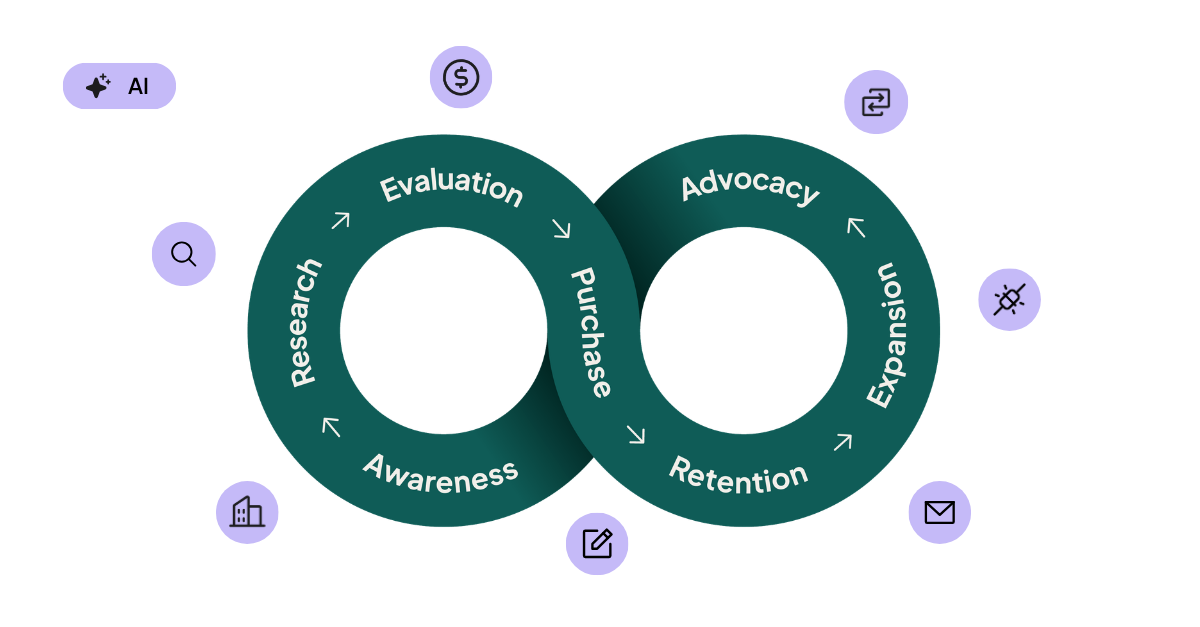
The relationship is still the centre, with AI as the accelerant. Your sales instincts remain yours, but AI helps you amplify them. Turning your good ideas into proven processes.
The Relationship Loop can therefore also be used as a framework for choosing which AI investments matter for you and your organisation. If an AI feature doesn't strengthen one of those three moments – find, catch, keep – it's probably just noise.
How to spot which AI investments are worth it
By now, you have probably seen a few failed AI pilots in your industry.
The pattern is predictable: vendors sell capability (“We have 50 AI agents!”), but when teams turn them on, the tools often go unused because the data is messy, the outputs aren’t trusted, the use case isn’t real, or setup outweighs the potential ROI.
Here's what to look for instead:
- Start with a specific pain point, not a feature list
Not "we want to use agents." But "we want to reduce the time our reps spend on admin so they can focus on relationships" or "we're losing deals because nobody follows up on time." One clear problem beats a long list of "neat features." When the timing is right, you'll see investments like closing the sales skills gap with AI agents, but only if the goal is clear first. - Check the data foundation first
Before you evaluate the AI, evaluate the CRM it lives in. Can it prevent duplicates? Can it enforce the fields you need? Can it integrate with your email and calendar so context flows automatically? If the CRM foundation is weak, no AI will save you. - Look for transparency, not just capability
Don't ask "How smart is the AI?" Ask "Can I see why it made that suggestion?" "Can I override it?" "What happens if I do?" "Can I audit it?" An AI that explains itself is more trustworthy than an AI that just gives you an answer (also a great standard for humans, by the way). Understanding what AI agents in CRM can do, versus what the marketing says they do is critical before you commit. - Measure in weeks, not months
If a pilot takes 6 months to prove value, it's probably not worth it. Real ROI shows up in 4–6 weeks: less time searching for customer context, faster follow-up, fewer manual tasks. If you're not seeing that early, stop and recalibrate. This was also the upside of AI trial and error in 2026, so make sure to listen to those learnings when deciding on a strategy for 2027.
What your team needs to know about governance
Here's the conversation you probably need to have with your sales team, and you probably haven't yet, have you?
"We're using AI in our CRM. Here's what it can do. Here's what we expect from you. Here's what we'll never let it do alone."
Most teams either oversell AI ("It's going to do your job!") or undersell it ("It's just a small add-on."). Both create distrust.
What to communicate clearly:
- Where the data goes. Is it encrypted? Where is it stored? Is it fed to OpenAI, or does it stay on European servers?
- What it's allowed to do autonomously. Can it send emails? Only draft them? Can it change records? Only suggest changes?
- What requires approval. Any message to a VIP customer? Any action that changes customer status? Any use of personal data?
- How to override it. "Copilot suggested this. I disagree. Here's why." That's healthy and how you build trust.
The best AI implementations have clear rules. Not because AI is scary, but because clarity builds adoption. And if you're concerned about data privacy in the context of AI, that's a conversation worth having with your vendor before you commit to scale.
The practical path forward: Three steps to operationalising AI in 2027
You're not starting from zero. You've run pilots. You've learned what doesn't work. Now you're ready to move from experiments to strategy.
Step 1: Audit your data, not your AI
Before you add more features, spend a week on this: What are the three customer fields that matter most to your business? (For most sales teams: owner, stage, next step, close date.) How reliable are they? Who owns them? When was the last time you cleaned duplicates? Fix those first. Everything else depends on them.
Step 2: Pick one AI use case and measure it properly
Not "roll out everything." But "we're going to reduce admin time by 20% this quarter using Copilot" or "We're going to catch at-risk customers two weeks earlier using our churn agent."
One clear goal. Four weeks. Measurable. And once you've proven one thing works, you can explore 4 ways to use AI in SuperOffice CRM right now – pick the next most valuable use case.
Step 3: Make governance visible and boring
Not "we have scary AI controls." But "here's where your data lives, here's who can see it, here's what we audit monthly." Boring (or explicit) governance is good governance, it builds trust.
Why a "European CRM" matters for your AI strategy
As you evaluate CRM options – whether you're in a pilot or scaling something that works – you'll notice a difference.
Some vendors treat European compliance as a box to tick. European data hosting? Sure, we have that. GDPR-ready? Yep, we got checked. EU AI Act? We'll update the docs.
Other vendors – vendors built in Europe, for European companies – have compliance woven into the way they think about product, data, and relationships from day one.
Psst! We’re one of those vendors.
When you're choosing which AI investments to operationalise, the vendor matters. A CRM that was built for European companies, with European data governance as a foundation, gives you a different level of confidence. This means that you are building on compliance, instead of retrofitting it to a shaky foundation.
For manufacturers, the deciding criteria is clear: 75% won't choose a vendor unless their data stays in Europe. A statement about what they need to operate responsibly.
FAQ
When you've measured clear ROI in four to six weeks and your team is asking for more, not resisting. If you're at 6 months and still "testing," it's probably not the right use case.
Features without strategy = expensive features nobody uses. Strategy with features = intentional, measurable, trusted. You're solving a real problem, your data supports it, and your team knows why.
No. But it has to be good enough for the specific use case. If you're using Copilot to draft customer emails, you need reliable customer history. You don't need perfect. You need trustworthy.
Ask where their servers are. Ask how they handle GDPR requests. Ask how the EU AI Act affects their product roadmap. If the answer is "we'll figure it out," keep looking.
Three things: (1) who has access to customer data and why, (2) any unusual patterns in AI usage or outputs, (3) consent and data retention – who can we still contact, who asked to be deleted.
That's when you know your oversight is working. Flag it. Log it. Learn from it. That's how you build trust in the tool: by catching and correcting mistakes, not by pretending it never gets it wrong.
The bottom line
2027 is when the difference between pilots and strategy becomes obvious.
Companies with clear intent, clean data, strong governance, and a vendor they can trust will move faster, close more deals, and keep customers longer. Their reps will spend less time searching and more time selling.
Companies that just add features and hope will keep asking "why isn't this working?" and their team will keep avoiding the tool.
The difference isn't the AI, but the strategy behind it.
Start with the data. Be clear on governance. Choose a vendor who understands European business and compliance. And measure from week one.
AI in CRM isn't new. But AI strategy in CRM – intentional, governed, trusted – that's what 2027 demands.


